“The festival will start small…”

This was a line in the Daily Advertiser article about the first Wagga multicultural festival, that took place last Saturday.  We heard about it a few weeks ago, and were thrilled at the thought of food and entertainment from around the world. So, after the farmers market, we zipped home, went for a long bike ride before it got too hot, then donned our sunscreen and hats for an afternoon of ethnic diversity…

And wow, were we disappointed! It was a disaster. There was a stage with bad entertainment (one we saw was just white Australian kids dancing), a jumpy castle, and a few of the normal booths we see everywhere. There was one booth doing African hair braiding, but otherwise, nothing we would call multicultural. And food? A booth selling cupcakes and one selling sausage sangas. We ended up going to Mates Gully, a restaurant we had been wanting to try, for lunch. It was very good.

Given how much we loved the Heritage Days in Edmonton, we had high hopes for this. Granted, it was the first, and the funding just came through recently so it was done on a small budget and short timeline. Hopefully it will be better next year. First real disappointment in Wagga.

On the upside, while at the market that morning, we took part in a research study about wine. One of the cool things about having a wine research institute in town is that there is research happening, and we are always happy to help! This was the second one we did this month.

Anyway, just a short post today, as it was supposed to be about the multicultural festival and that isn’t worth writing any more about.

And also, it has to be short because we have to run out right now for chest x-rays as part of our application for permanent residency. Yes, the paperwork begins again…stay tuned for details.

Posted in festivals, Visa, wagga, wagga wagga, wine | Leave a comment

Hot and stickie

When we told people in Canada (those who know about wine) what part of Australia we were going to, most had no idea where the Riverina was located. It is actually a distinct wine region, but not a famous one. Outside of Aus, the best known regions are probably McLaren Vale, Barossa, Margaret River, and maybe the Hunter, Clare and Eden Valleys. Riverina, though there are some good wines made here, is really a place to grow grapes for goon. Other local areas include the hilltops (around Young…Clonakilla Hilltops Shiraz is wonderful!), the central tablelands (near Canberra…the Clonakilla Canberra Shiraz is out of our price range!) and Cowra (a small town that actually has its own microclimate and is designated as a wine region; there are some really good wines from there, such as Pig in the House Shiraz). Most of these, however, are quite unknown outside of this area.

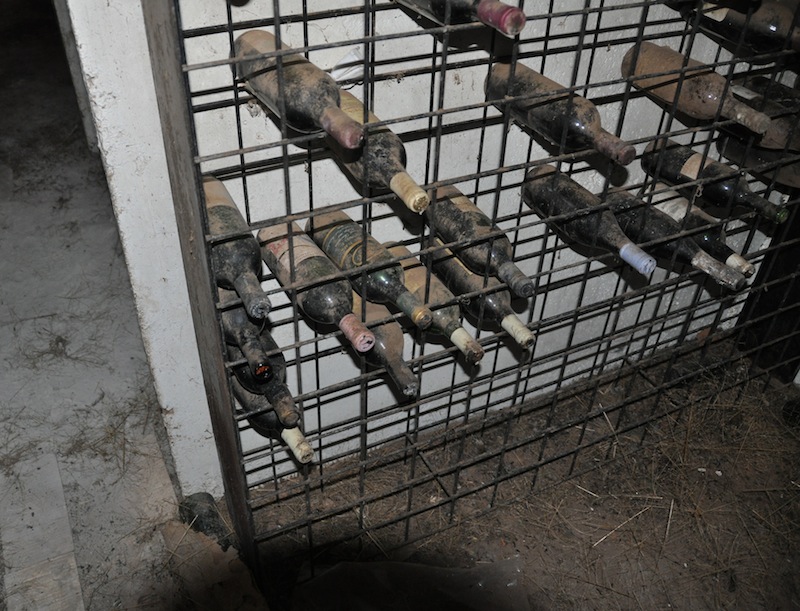
Our first visit to a regional winery was a mothballed Lindeman's winery, now owned by the people we were visiting. The vineyards are now pasture, and the wineshed houses farm equipment. But in a far corner is a storehouse of local wines from the 1980s...the Australian heat hasn't been good to it. We actually opened two bottles, both of which were horrible. These may have been Chris Pfeiffer's own stock.

But, when we said to wine people that we were going to be living a 2-hour drive from Rutherglen, their eyes would light up. Because, for those in the wine know, Rutherglen is a gem. But, now that we have been there, we’re not sure if even the oenophiles know just how spectacular Rutherglen is – unless they’ve been here, of course. While in Edmonton, we drank a bit of wine from Rutherglen (which is a pretty small town). Not much though, because it’s most famous for its “stickies” – thick, sweet, succulent, yummy dessert wines, mostly muscats – so that’s what we tried. The hot temperatures in the region are ideal for growing muscat and other grapes used to produce fortified wines. We had some pretty great ones in Canada, from Chambers Rosewood and Bullers. And since we’ve been here, we’ve also tried others (Stanton & Killeen, for example).

The Murray River is the border between New South Wales and Victoria; Corowa, where we were last weekend, is on the north (NSW) side of the river. Rutherglen is about 10 km south of the river, in Victoria. So when we were visiting the Corowa region last weekend, we had to go. And we were quite enlightened by what we found on our Sunday morning jaunt to some cellar doors (the term they use here for where you can sample and purchase at the wineries). Unfortunately, it was pretty windy and threatening rain; so Dan and TP’s plan to bike it (while Lisa and LCP drove, filling the boot with purchases) was shelved. We all piled into the car and headed to the wineries.

Wines at Cofields. Note that in the bottom left corner there is a kid's desk. Wineries in Australia are family affairs. How civil!

First stop was Cofields winery. It isn’t actually in Rutherglen, but Wahgunyah, a pretty much non-existent town just across the old bridge out of Corowa (as opposed to the new bridge…that would lead to All Saints winery).  Dan sampled a few wines, being very selectively restrained actually, as it was only about 10:15 in the morning. There were a couple he thought were worth Lisa trying too. Their Marsanne Viognier blend was quite nice, and they also made a good Durif (Australian name for Petite Sirah). We bought a few bottles and joined their wine club – so now, they will ship us a case of assorted goodies every 6 months. And for good will, as we were leaving (well, when Dan finally noticed that Lisa and all were already gone) the cellar door guy handed over a Cabernet Sauvignon, on the house.

As a Pfeiffer club member, we get a discount on picnic hampers...anyone want to join us for a Sunday afternoon lunch here? Award winning wines, turtles (they even supply food) and platypusses (platypi?). We didn't see the latter, but they are there.

Then, it was a quick trip down the road to Pfeiffer’s, still in Wahgunyah. Chris Pfeiffer used to work for Lindeman’s, one of the big Aussie wine companies, but went out on his own. Now, his daughter Jen is taking over, and winning tons of awards, including Young Winemaker of the Year for 2011, and her wines are also cleaning up at competitions both here and abroad. Since it was by now almost 11 am, it was OK to sample more broadly. We ran through most of their range, skipping out on the sparkling wines and a few of the others, but tasting their delicious Pinot Noirs, Shirazes and a few whites. And some stickies. Oh yeah, Rutherglen stickies.

As we’ve already said, Rutherglen area is known for stickies. Outside of Australia this typically includes ports, muscats, late harvest whites, and maybe dessert wines made from botrytis-affected varietals normally used for table wines (like Semillon or Riesling). But at Pfeiffer we tried a couple of Topaques, and damn were they good! Topaques are (OK, we might not be 100% accurate here!) a cross between a bunch of different dessert-wine styles: botrytis-affected Muscatelle grapes, made into a fortified wine. So, double yummy sweetness and complexity. Wow. The name was actually coined by Chris Pfeiffer, after the European wine control people told Rutherglen winemakers that they couldn’t use Tokay/Tokaji anymore, because that name was trademarked in Hungary. So the Victorians came up with Topaque because the resulting wine is topaz in colour and opaque. And, did we say this yet: delicious. OK, let’s say it again: DELICIOUS. Google Topaque (or lmgtfy) and you will get the whole history and a bunch of stuff about how it is Rutherglen’s hidden gem. We won’t even attempt to describe it – if you like wine, try to track some down. If you like dessert wine,  come here…we can take you to the source(s) where you can try more different ones than you imagined.
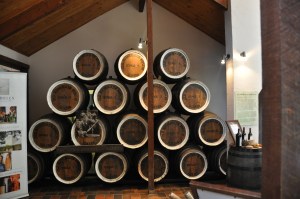
This solera system in the Campbell's cellar door is, we think, still in operation. Wine geeks will understand it...anyone else, come on down and have the winemaker explain it.

Then, after Lisa, TP, and LCP went off to look at turtles (the winery folks will even give you food to feed the turtles, too – something to keep the kids busy!) while Dan played wine geek, we finally left Pfieffers with another case and another club membership. And then into Rutherglen proper, to Campbells. Campbells is a bit more slick – their cellar door obviously cost them a lot more than either of the other places had spent. But just because they are good marketers doesn’t mean they aren’t also good winemakers. We had tried a few of their whites before (found them baking in a little drive-through liquor store in Wangaratta). They make wines that are a bit unusual for Australia, such as Trebbiano and Gewurztraminer. Both of these are really good, especially the Trebbiano. This region and the King Valley (which we will post about next year…we’re going there for a holiday) have people experimenting with lesser-known varietals, often Italian, and quite successfully making a fantastic alternative to the better-known Shiraz, Cab Sauv (Aussie say Cab Sav…not understanding the French origin), and Chardonnay that are common in Australia.

Jones don't make wine with the figs that grow on their property. Oh, did we mention that people grow figs around here? FIGS! How cool is that...and we had someone point out to us one that is near our house that we can probably sneak in and pilfer some!

Keeping with the trend, Dan chats and tastes while Lisa and our hosts stand at the door waiting for him to notice that it is time to go (Lisa edit: for the record, I did taste many wines, too… just not EVERY wine). And when he finally tore himself away (this time with a 6-pack and another membership) it was off to Jones winery. This was the smallest of the four, and makes only a few still wines along with some ports and muscats and topaques. The highlight here was port…so a bottle of that came home with us too (and yes, another club membership). We had planned on dining at Jones, but hadn’t gotten around to making a reservation; and, since it was hot and sunny, everyone was out in Rutherglen…they couldn’t seat us for another 2 hours! So we ended up at the Rutherglen wine tourism centre for lunch, which was surprisingly good for a tourist office. And there we also got to see the huge (HUGE!) variety of wines available in the area – easily a couple hundred different labels, all from within maybe a 20 mile radius.

We missed a few wineries that we wanted to check out, such as Chambers Rosewood and All Saints. But we’ll get to those eventually. What we learned on this day out was that we don’t want to shop in Woolies and Liquorland any more. We would rather support the wineries directly, and it is so easy to do here (even around Wagga, there are a few wineries to visit; we’ll review those another time). And also, we won’t have to be doing too much shopping anyway, as all the memberships Dan signed up for include cases to be delivered at various times throughout the year. Lisa will need to hide his credit card very soon!

And we came away with information about a lot of events in the Rutherglen…cycling weekends, wine dinners, etc. And recommend anyone thinking about visiting us ask about those dates before booking their flight/days off…it is a place not to be missed.
Posted in Australia, Canada, Corowa, Cowra, durif, Edmonton, muscat, Rutherglen, stickies, topaque, wine, wineries | Leave a comment

sheep dip

Last post, we talked about the cropping component of the farm our friends own. Now, it is time to talk about the sheep. On the 2500 acres of paddocks, at any one time they devote about 30% of the space to pasture, while the rest is crops.

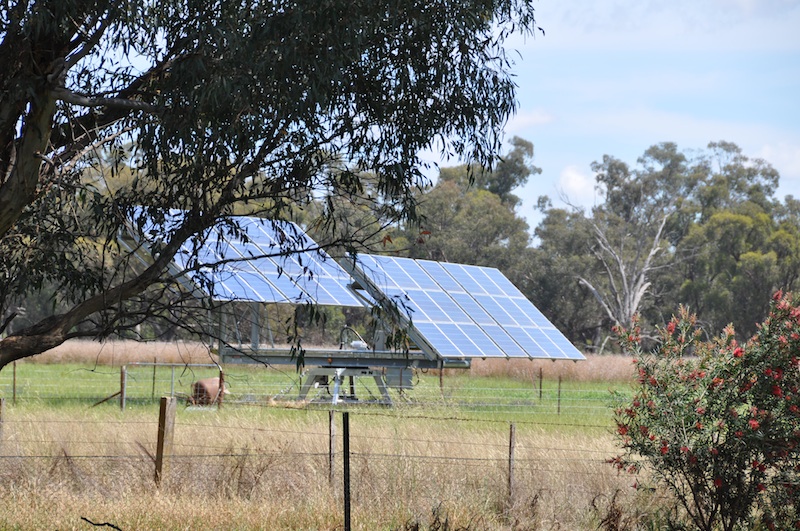
Another means of diversification is dedicating a bit of space to a solar pane. This thing is computerized and follows the sun, to maximize output. It powers the house, pays for itself, and generates a small profit each day.

The pasture serves a few purposes. One, it diversifies the farm. A farm based only on crops is taking a chance on a lot of things: growing conditions, market forces, etc. Sure, livestock also has these variables, but by working with a mixture of both crops and animals, chances are that most years at least one of them will be profitable. And there is a really complex mathematical process that determines how much land should be pasture and how much crop.

Sheep at pasture are counted in terms of DSEs: dry sheep equivalents. That means how many sheep you can pasture on an acre of land. One ewe and one lamb are 3 DSEs. The fat lamb is worth $x at market, the ewe’s wool is worth $y when sheared (taking into account, or course, the cost of shearing, etc).  So depending on how many DSEs your land can support – which in itself is complex based on the type of grasses in the paddock, whether it actually has irrigation, etc – you have to figure out if your land is worth more as pasture or crops. And if a crop, what crop? This depends on how many tons per acre yield you get, how much each ton is worth, etc. Isn’t farming fascinating?

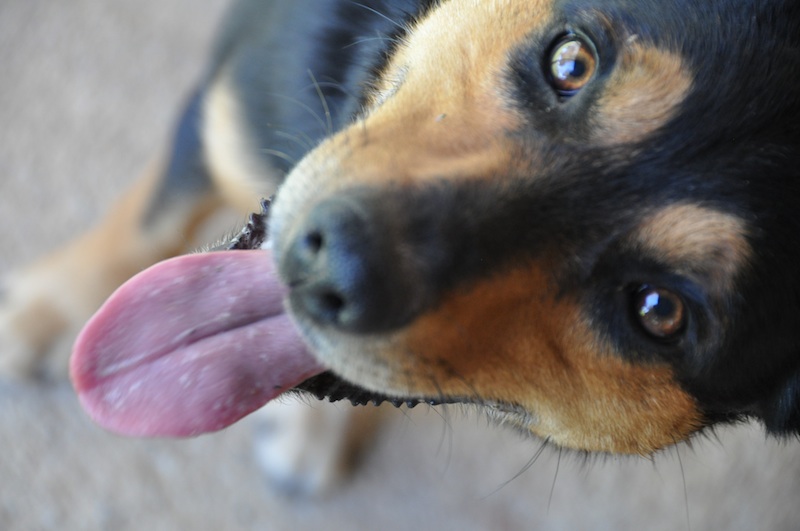
We didn't actually get around to taking any photos of sheep. So here's a photo of the thing that Dan saw most over the weekend: Larry's tongue as he stood at his feet, waiting for a stick to be thrown.

But then there is the next level of complexity, which we mentioned last post: crop rotation. Every few years, it makes sense to take a paddock out of cropping and let it be pasture, because it will help regenerate the soil, in turn upping the yield next time you sow a cash crop. That benefit is one that is hard to quantify, but has to be take into account. So, one of the things we learned on this trip is that farming is a science. A very precise science. Or more accurately, a lot of sciences: botany, meteorology, economics.  But it is also a craft. And an art. And damn hard work both physically and mentally, and one that takes years to learn. Farmers work 24/7, living and dreaming about what the work they need to do every day and worry about what nature will throw their way. (Lisa edit: Just like academics! Only farmers get sweatier and dirtier… well, most of time).

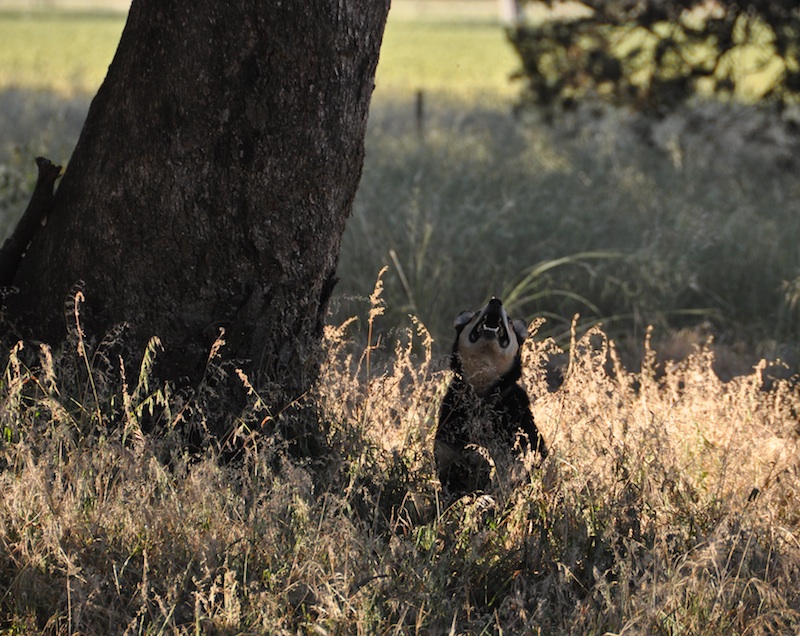
This is Badger. He is not only good at herding sheep, but he is good at treeing ring-tailed possums (possi?). He had a pair up there, and wasn't going to let them come down.

The farm we were on has, typically, more than 1000 sheep. Some are lambs, there for a short time, being fattened for market. Some of these lambs are purchased, fattened and sold. Some are bred there, with the ewe also bringing in income from the wool.

When we were there, TP had to work late on the Sunday night rounding up sheep to spray them for fly strike. There is a strange fly here (Australian sheep blowfly [Lucilia cuprina]) that lays its eggs on the sheep; while that fly doesn’t really do any damage, it creates an environment for other, more problematic flies, to also lay eggs. So, when it starts to strike, they have to quickly round up the sheep, bring them to the yard at the shearing shed, and spray them. With over 1000 sheep, this is a tough job. And this weekend, it was made even tougher by the fact that about an hour into the job, there was a “rain event.”  It poured. Horribly. TP and Luca got drenched. The sheep stopped moving. Even Rocket, the adorable kelpie with a deformed jaw (that means she can’t keep her tongue in her mouth), just shut down. So, a crappy job that should have taken them until early evening took many hours, and TP didn’t make it back to the house for dinner until about 8 pm. Farming, it seems, isn’t a fun job.

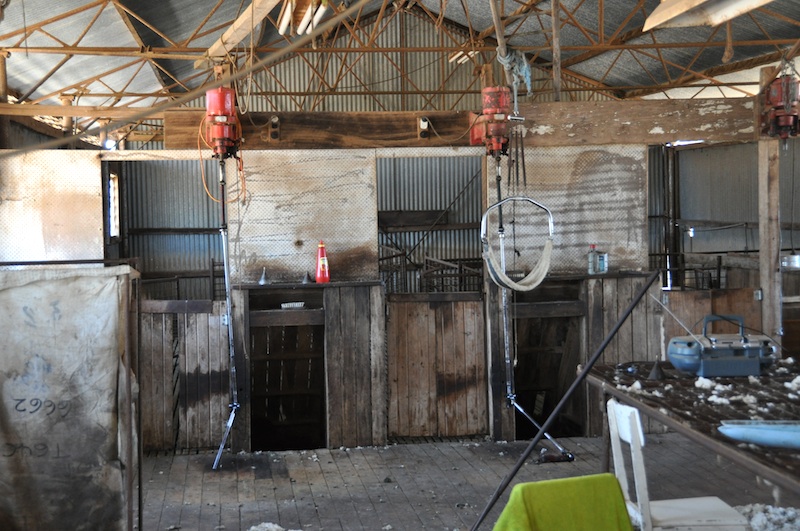
Shearing shed? Or some strange torture chamber? The best part about this is the bottle of tomato sauce (sort of the Aussie ketchup) in the background. Do the shearers actually eat lunch (probably a pie or a sausage sanga) here? Yuck!

On the afternoon component of the Saturday farm tour, we visited a couple of shearing sheds on the property. These were pretty interesting old buildings (that forced Lisa to get over her spider fear!). They are old and run down, designed for one purpose only. Both of the ones we went to were OK, but not great. The shearers work on ground level, which means the wool gatherers have to bend to pick up the wool. A better shed, according to TP, would have the shearers work on a platform, so the wool could then just be grabbed at chest height. This is not only faster, but also easier on the gatherers. Australia is very much an OHS country! Shearing sheds are pretty cool, but unfortunately something that is dying out as the wool industry gets smaller. They used to once be prominent on the Australian landscape, but many have gone into disrepair. Fortunately, someone is documenting this heritage before it is gone completely (and see here too).

On the way home from the sheds and the fields, we stopped off at a neighbour’s house to pick up a lawn mower. The grass at Bilawi needed cut, because they keep it well watered. This isn’t just for aesthetic purposes: it is a safety measure. Green grass burns slower than brown grass, and in Australia you do everything you can to slow down wildfires.  While we were there, the sprinklers around the house ran most of the day, drawing water from a dam on the property where most of it would be collected again, later. If a fire raged through the area, it would destroy the crops but the house would be safe.

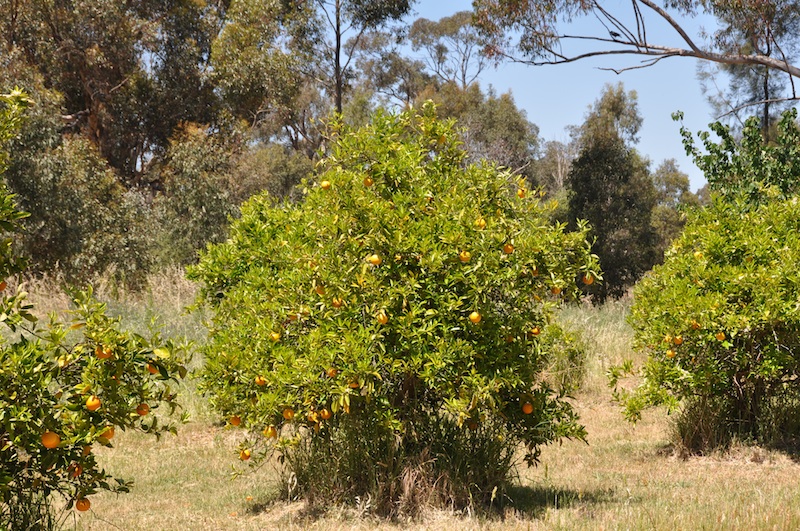
We were surprised at the small size of orange trees. This small grove also had grapefruit (we got a dozen of those), tangerines, lemons, and figs that were just starting to ripen.

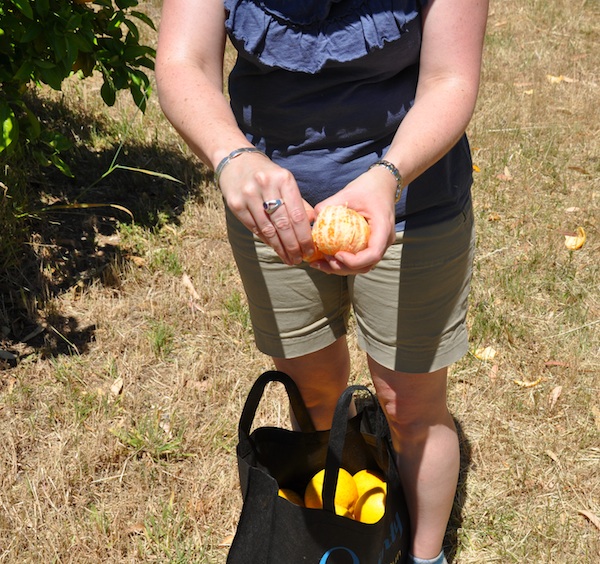
While at this neighbour’s house, we raided a small citrus grove. The orange and grapefruit trees were still bearing fruit, but the lemons were done for the year. We picked a huge bag of fruit and ate a few things there. There is nothing in the world like eating an orange right off the tree on a 33 degree day. Heavenly! Unfortunately, the figs aren’t ripe yet but we are waiting for that season. We also ate mulberries, fresh from the tree. Amazing!

There's nothing better on a hot day than a hot orange fresh off the tree. Yummy!

The whole environment here still boggles us. People here take it for granted that there are grapefruit and figs and kumquats; they take it for granted that somewhere in the country, there is always fresh fruit. Sure, Queensland might be a ways away, but it isn’t like in Canada where we were getting fruit from South America.  It also drives us crazy that our neighbours have left mandarins on a tree in their backyard, untouched for weeks! Dan’s been planning a midnight raid. So we marvel at things like going to pick grapefruit; maybe some day we will get used to it, but we will never take it for granted. And we can’t wait to plant our own trees!

Posted in agriculture, Australia, citrus, Corowa, farming, sheep, sheep shearing | Leave a comment

down on the farm

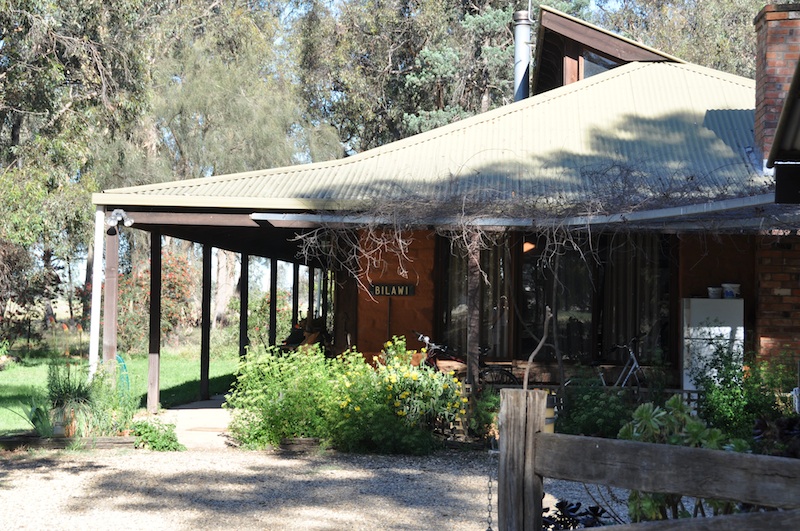
The farmhouse, Bilawi (Wiradjuri for "she oak") was built by the owners. They used timber from a local bridge, home-made bricks, and many recycled components. It was beautiful.

We have just returned from one of our most exciting weekend adventures yet – a trip to a real, live, working farm near Corowa. One of Lisa’s colleagues (LCP) invited us for a weekend away a few weeks back; she works at CSU in Wagga and commutes each week (Mon-Fri in Wagga and weekends back on the farm), keeping two homes in order while working as a full-time academic (whew!). Their family also runs a BnB on the property, called Oakleigh; it’s definitely worth the drive!

This is Larry. Every time we would go outside, he would drop a stick at our feet. When this didn't work, he would drop it on our feet. Larry is very persistent.

So, after a long workweek we followed LCP (caravan-style) to her rural home. And what a home it is! The drive was another lovely route, less than 2 hours drive southwest of Wagga; we stopped in Uranquinty for a late lunch at the Quinty Bakehouse (for meat pie – what else?) and to pick up some bakery provisions for the weekend. Our first evening was a quiet one at the farm. We first met the 6 (!) resident kelpies, who swarmed our car while yelping and jumping happily. Rascal, the old (retired) gentleman, peed on our front tire, claiming the Kia as his own. Larry (LCP’s daughter’s pet) promptly brought us a stick, begging us to play fetch; this would become a recurring theme throughout the weekend, with the “stick” ranging from a tiny sliver to a garden fence rail! He’s a bit obsessive, to the point that it might be a good project for a veterinary psychologist.

It was a bit of a challenge keeping track of 5 kelpies (Rascal, the elder of the family, doesn't leave home these days) but it has to be done. The risk of snake bite is pretty high, and if one gets bitten they have to be rushed back to the farmhouse for some medication, then to the local vet within 2 hours. The owners aren't too happy with snakes - they've lost a couple of dogs over the years.

After a spot of tea, we decided to take the dogs for a walk around the property. We stayed on the road, since this is serious snake territory; in the Corowa area you can find lots of brown snakes, curl snakes and pythons. Happily, we didn’t see any snakes; we knew that they were there and had to call the dogs off of something interesting in the bush at one point (near the dam, where the snakes come to get a drink in the evenings). The property is also home to goannas, possums, and many, many parrots.

The next morning we went for a 23 km bike ride around the neighbouring farms. It was early morning, so still cool and fresh (before hitting a high of 31 Celsius later in the day). Our bikes did very well on the harsh gravel roads; there was little traffic at that time of day, but we waved at all the utes that went by (just like rural Canada!). After grabbing a shower and a hearty breakfast (with mangoes and cherries and honey… oh my!), we set out for a guided tour of the farm. Now, this wasn’t just any old tour, where the city folk are safely ensconced in an air conditioned vehicle, marveling at the colour of the hay  in the fields. Oh no! This was a hands-on, get your hands dirty, do a bit of work while you’re here, kind of tour, led by LCP’s husband TP. We all piled into the first ute of the day, a CB-equipped, working vehicle; unfortunately, there was only one bench seat, so Dan had  to (Dan edit: got to!) ride in the back (totally illegal, mind you; think of riding in the back of a pickup truck – but with lower sides – and you’ll get the picture). We didn’t go too far; just down the road a bit where we traded this ute for one with a crew cab.

We didn't see any reptiles on the farm, but we were obviously very close to a goanna. This track across the road was still fresh (hadn't been run over by a car tire yet) when we walked over it.

Then, it was off to paddock #1, where we met a fellow temporary resident, a field-hand named Luca, who had traded working on a dairy farm in Italy for this mixed (crop plus sheep) farm in Australia. He was busy using his tractor to rake hay into windrows, so that the crop could finish drying. This is where the real fun began! Dan jokingly mentioned to TP that Lisa had experience driving tractors; she had once driven a small John Deere tractor with a trailer full of beer at a party hosted by a former Dean of Nursing at University of Alberta, on the Dean’s farm (don’t ask!). TP thought this was just the right experience to train Lisa for having a go at raking hay, so off they went for a little bit of tractor work. As TP said, it was a good chance to see if the theoretician could do something practical! The answer? Why yes she can! Luckily, Lisa can drive a stick shift, so was able to master the clutch and gears (turtle vs. rabbit; they are labeled with pictures of these animals, so you know if you want to go slow or fast). She had to steer the tractor to keep it in line with the middle pile of 3 piles of hay, then lower and raise the rake at just the right moment to guide the 3 piles into one long windrow. TP declared Lisa’s windrows very neat and orderly (she is a trained librarian, after all – so what did he expect?).

If the CSU job doesn't pan out, maybe Lisa can apply for a temporary, rural worker visa and go do some farm work.

Next, it was off for paddock inspections. We toured the various crops and had a detailed lesson in the differences between wheat, triticale (a cross between wheat and rye), lucerne (what Canadians call alfalfa) and barley. We learned all sorts of information about the land, watering, cutting, etc. We learned, for example, that rainfall patterns in Australia are very predictable when there isn’t a drought – or even in a drought, really. TP explained that he planted one kind of barley on the west side of the road, because it got more rain than the one on the east. He detailed differences between farm areas around the region, and how just a 35 km difference can make a difference in what kind of crops are suitable. And the value of land, he said, was in how much rain it gets: when buying property, that is the key factor and farmers need to understand that when purchasing and planting.

Modern farming technology is amazing. To plant in a straight line, the tractor is controlled by a GPS. When this field is sown next year, with a different crop, the GPS can be set so that the seeds are planted 25mm from this year's seed line.

We also learned a lot – a hell of a lot – about crop rotation, mixed crop planting, cropping versus pasturing, and the techniques TP uses to manage soil quality. It isn’t an organic farm, which given the type of people they are was a bit surprising (LCP said that TP is sometimes referred to as a communist!). But there are a number of problematic crops that grow, and organic control methods such as plowing them under, aren’t sustainable in the Australian environment; as we mentioned in our gardening post, there is almost no topsoil here, and plowing the ground would be detrimental to moisture retention. So, minimal use of herbicides is necessary.

All this… and it was barely lunch-time! The rest of our visit included shearing sheds, a lot of wineries (including a old, mothballed Lindeman’s winery), tales of protecting sheep from fly strike, a trip to the Corowa market… all sorts of fun. Watch this space for part 2 of our farm-land adventure…

Posted in agriculture, Australia, Corowa, cycling, farming, kelpies, rural life, utes, wildlife | 1 Comment

red dirt girl

One of the attractions of Australia, as we have mentioned ad nauseum, is the climate. We just got tired of the cold and snow in Edmonton. And we also got tired of planting flowers every year that didn’t do much, and planting tomatoes that we never got to harvest because they didn’t ripen before the first frost. So, one of the benefits of this climate is that we will get to garden. We like to garden; we might not be any good at it, but we like to try. And we think Wagga might be a good place to learn how to do it well…but we know we have a lot to learn, mostly because of the different conditions.

No idea where this photo (gleaned from someone else's website) was taken, but it is a good example of the kind of alien landscape we are living in.

Australia has, so we’ve been told, the thinnest layer of topsoil of any continent. The person who told us that is pretty knowledgeable about Australian geography and flora, so we believe him. What there is here is a lot of fine red dirt and clay.  When you drive around NSW, you see it everywhere – mostly in the creek beds that have eroded; but anywhere that doesn’t have vegetation is more likely going to be red than black. We don’t know how this is for backyard gardening, such as flowers and tomatoes, but it is good for potatoes. Canadians: think PEI. Potatoes in stores here come coated in a red, sandy soil…they say they leave then unwashed because the soil protects them from the sun.

We have a lot of space to plant flowers in our back yard (is it yard or garden? Brits call the whole thing garden, so do Kiwis. But we think that Aussies actually use yard). But because we only want to be in this house for a few more months, we don’t want to put a lot of effort or money into it. We couldn’t, however, not take advantage of the climate and do some gardening.

We had asked the property manager about gardening, and they said it was OK as long as we returned everything to its original state when we moved out. This specifically referred to our query of whether or not we could rip up the useless paving stones in the north east corner of the back yard and put in a veggie patch, but we also didn’t want to do much in the existing shrub bed that we would have to undo.

This is the kangaroo paw that we were given. Sorry if the photo doesn't actually show you what the plant is like - Dan was trying to be artistic.

But then, on the Canadian Thanksgiving weekend, we had a house-warming party/Thanksgiving party. And as people are known to do, they brought us house-warming presents: one person brought us a large pot of something – we can’t remember what it is, but it is native to Australia – from her garden. Another couple brought us a “kangaroo paw”; yes, there is some official latin generic name, but that is stupid because it is an Australian plant…it should have only an Aussie name…sure, maybe an English settler name and an Aboriginal name, but the latin one means nothing.  We hadn’t planned on doing any gardening, but when these arrived in pots, we thought “hey, we’ve got a huge alfresco (Oz for patio), why not do some container gardening?” So, the next weekend, off we went to Bunnings (the Oz version of Home Depot).

The cheap plants don't even come with tags saying what they are - they are just generic 'potted colour'. This is summer colour, we don't know what winter colour will be.

We found some pretty spectacular stuff! Unfortunately, most of it is what we want to invest in later…there aren’t really ‘annuals’ and ‘perennials’ here, like there were in Canada. There were a lot of flowering shrubs, a lot of native Australian plants, and a lot of what were listed as “seasonal colour” – the things that in Edmonton we would have planted in late May and hoped they lasted into late September. Pointing to the mature plants (10 cm pots, blooming) the guy in Bunnings said (something like) “if you are renting, these are the best choice. If you get sick of them or move after seven months, no worries, just buy some winter colour (whatever that is). And they’re only $2.” OK, $2 for a pretty big lavender plant, or osteospermum, or carnation…we’re in! So we stocked up on a bunch of those, found some nice planters for the alfresco, and headed home to dig in the red dirt.

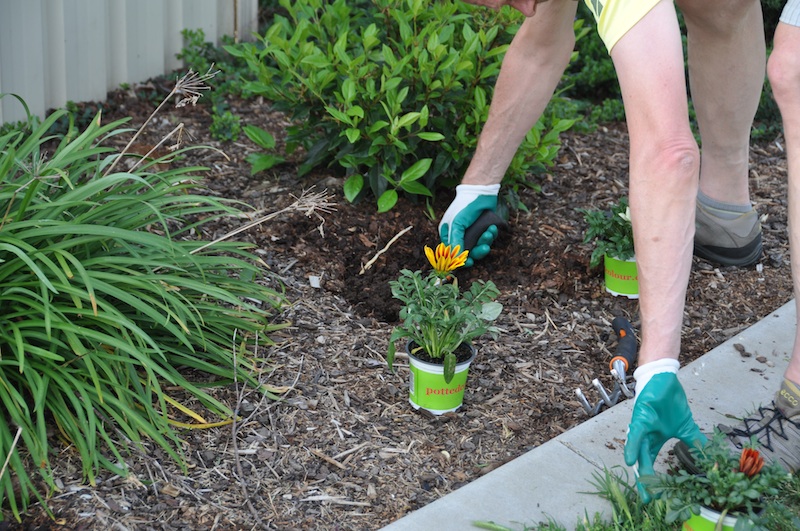
This is Lisa getting over her fear of the garden bugs. Pink gloves for girls, green gloves for boys.

Digging in the ground here is…well, it is a bit different than in Canada. Even just mucking around in plants is different.  Because in Canada we didn’t worry about spiders so much. Sure, there were spiders there, and we would often see them when gardening, but we didn’t worry about them. They weren’t dangerous. Here, there are red backs and white tails and who knows what else. So, Rule #1 of gardening (as set by Lisa, who yells at Dan when he breaks it) is WEAR GLOVES! And rule #2, as suggested by a friend, is that if  you leave your gloves on the ground, STOMP ON THEM, HARD, BEFORE PUTTING THEM ON This will kill whatever has moved in. (Rule # 3 is WEAR SUNSCREEN AND A HAT! – coming soon is a “The sun’s different here” post.) And, rule #4 is WATCH OUT FOR SNAKES; we have many bushes in the back yard and there is only a two-lane road between our back fence and rural bushland. Of course, we have already determined that the birds in our backyard can act as an early warning system. If they disappear, we know we’re in trouble!

The aptly-named bottle brush tree in our back yard. That is a blue eyed honeyeater enjoying the flower.

The beds at the back of our yard have some bottle brush bushes (beautiful!), some other flowering bushes, and palm trees. They are a bit of a mess, and who knows what lives in there besides fairy wrens and honeyeaters (see rule #4!). Dan went in, fearlessly weeding the shrubby areas, and planted the first bunch of flowers. We quickly realized that we hadn’t bought enough, so on Sunday went back to Bunnings for more.  Because Dan had other things to do (like learning how to install the bike carrier on our car, for upcoming trips) Lisa donned her pretty pink gloves and did some planting.  She finished the beds at the back and the patio pots.

Now that we have stuff in the ground or in pots, we have to learn how to take care of them. Does ‘drought resistant’ mean that it doesn’t need much water ever, or do you have to water it until is is established?  How much water does a plant need in 45 degree heat to live? Our house has a sprinkler system, so we ran the program that was already set; if that was what a previous tenant used it must make sense.

This is how thee planters looked when we planted them...now, just a couple weeks later, they are filled out so much you can't see the dirt. Things grow fast here!

On the weekend that we planted, temperatures got up to about 33 Celsius, and it was quite sunny. Perfect weather, really. And things seemed to do OK for a few days. Then about a week later, we noticed that some of the carnations and gazanias in the back beds were drooping. Was it too much water, or not enough? Dan opted for the latter, and soaked them, and the next day they had all perked up. So, maybe the sprinkler settings weren’t right; maybe the previous tenants didn’t know a hoe from a ‘ho? We’re curious to see how things progress. Now that we kind of have the watering figured out for now (and we’re thankful we have an in-ground sprinkler; that’s on our new house wish list, for sure!), how do we continue into the summer? Does the lawn need more or less than the flowers? And will what we learn in the rental be transferable to  wherever we buy?

We didn't see this at Home Depot! But at Bunnings, there were lots of different citrus trees to be had. These ones were patio size. We were tempted, but thought we should wait for our own place.

We’ve already been told that when we move into our house, people will give us cuttings. Things grow here so well that they want to thin them anyway, so why not pass a chunk along (too bad that citrus trees didn’t propagate in the same way – we’ve actually seen branches of lemon and orange trees laying on the riverbank where they’ve been discarded, fruit and all!). One of Lisa’s colleagues mentioned that a woman had given her a few (!) Japanese maple trees (Dan’s favourite), because the yard was overgrown. She was going to throw them away (!). Such a different world.

Posted in agriculture, gardening, rural life, weather | Leave a comment

all the news that’s fit to wrap

Very…well…wrapped. So well wrapped, there are some days it just seems easier not to bother unwrapping the thing. Indeed, some days, the newspapers aren’t worth reading anyway; such is life in rural Australia!

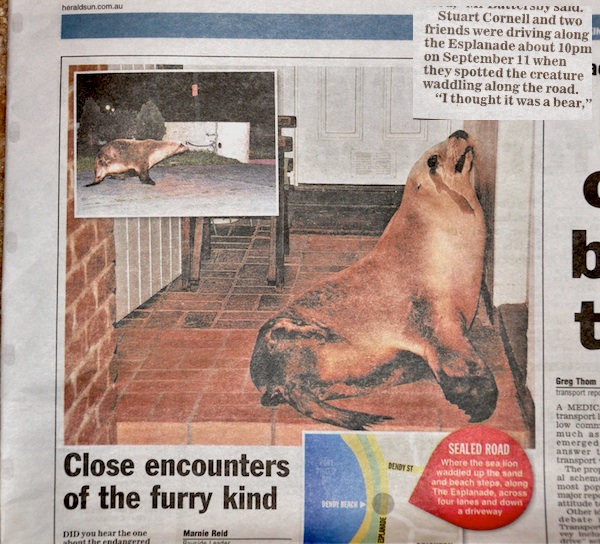
This story wasn't in one of the papers we get here, but in the Melbourne paper when we were there. It is about a seal that wandered through the city, and ended up at someone's door. The best part is the bit that we cut and pasted into the top...someone who saw it who thought it was a bear! Australians are obsessed with, and very afraid of, bears.

Back in Canada, we read two papers a day: The Globe and Mail (we still follow it on Facebook!) and The Edmonton Journal (a real rag, which we don’t miss!). We still get two newspapers delivered each day (well, Monday through Saturday because there is no Sunday paper here…which is silly because that’s the best day for reading a paper): the Daily Advertiser (local) and The Australian (national). Our subscriptions here, though, are a bit odd. When we first moved into the house, Dan called the Advertiser (as we call it…why waste two syllables) to subscribe. They told him they would deliver it, but 2 days late. If we wanted it on its publication day, we had to call the local news agent (what’s that?). So Dan found the creatively-named Kooringal News Agent (since we live in the suburb of Kooringal) and inquired about subscribing. You don’t really subscribe, you just pay the news agent to deliver that day’s paper. It costs the full cover price ($1.40 weekdays, $1.70 Saturday) plus 60 cents for delivery.  Sure, why not…more convenient than going to get it every day.  Then Dan asked about The Australian. Sure, the newsie says, I can deliver that too…cover price plus 60 cents…or you can just call them and subscribe at a discount. So Lisa goes online to The Australian and subscribes at a 40% discount and no delivery fee; a great deal! So we now pay double the price for the local paper vs. the national one – strange! Even more strange…? We then get a call from the Kooringal News Agent confirming our subscription start date. Turns out, he’s the one delivering both! Which is convenient, because when we go away we just call one person and put a hold on both papers.  The funniest part of all of this, though, is that the two papers get delivered separately; we hear the Advertiser hitting the house/lawn/mailbox (wherever the guy throws it) about 6:15 a.m. The Australian arrives some time between 7:25  and 8:00. Very inefficient…

But, well, back to the point of this post: the really funny/strange thing isn’t that they are delivered separately, but that they are wrapped – seriously, tightly wrapped – in a Saran/Glad wrap type of material that is really hard to remove. It’s obvious that they start with the flat paper and then roll it (by machine – we hope!) until it’s super tight, rip the plastic off (what we can only imagine to be) a really long roll, and then move on to the next one… But the wrap is really hard to get off. Really hard! Really, really hard, most days. You know that life is sad when you’re excited that you can easily find the free edge and pull the wrap off, quickly. In fact, another local paper (The Leader, delivered free every Thursday) ran a weeks-long campaign advertising a new “flat wrap”; think of the type of plastic wrap that covers a magazine when delivered in the mail. This was big news here in Wagga! For weeks, they ran testimonials in the paper about how everyone was excited that they didn’t have to struggle to read The Leader. Seriously (and yes, we love the flat wrap, too)! If you can find the end of the wrap, life is good. But most days, it’s a bitch… Think about finding the end of a roll of packing tape and you’ll know what we mean.  Some days, we just take the scissors to it (but that’s not as easy as it sounds… you can end up with a pile of Saran pieces all over the counter and small cuts in your paper – which is particularly troubling for Lisa; she’s one of those people who likes a fresh, crisp paper with no sections or pages out of place).  And then, when you finally get the paper free from it’s strait-jacket, the damn thing stays curled up in a tight roll! This makes it hell to read. One (local, Aussie) friend told us how he unwraps his, puts it in a hot oven for a minute, takes it out and lays a heavy cutting board on it and goes to work…this, supposedly, flattens it well. Seems like a lot of work, but he says that is the only way to do the crossword. How did he figure that out? Lisa is considering applying for a research grant on this very topic — the information-seeking practices of individuals trying to dewrap their local news.

Our 3 Thursday papers. The Leader in its 'flat pack', and the Advertiser were both put in the house before we went to work. The top one is The Australian - notice how it is actually browner than the others. As the Aussies, say, "The sun is different here".

To go a bit more off topic, we leave home at 7:30 each morning. If The Australian (which, by the way is a horribly conservative paper — owned by Rupert Murdoch, enough said – but probably the best source of info for us) isn’t here when we leave, it sits on the lawn for 8 hours. The sun here is so strong (no ozone layer over Australia, eh!) that it gets a tan. Yes, a tan! The part that is exposed to the sun turns brown. This happens while we’re at work – in only 8 hours. Seeing this reinforces our need for sun screen at all times!

And, we started off by saying that the papers aren’t worth unwrapping sometimes. So, how bad are they, you must be wondering (especially those of you who are familiar with The Edmonton Journal – or even the London Free Press, our previous rag of choice in London, Ontario)? Let us tell you.

This is the kind of local story that keeps us buying the Advertiser. Without it, how would we know when to put cable ties on our bike helmets for protection?

The Daily Advertiser is full of court news from the local towns. Pretty humourous actually! And reports on the local shows. On Thursday, it has an insert called “The Rural,” which is all about farming. It is great if you want to know the price difference at auction of Dorset and Merino lambs, for instance.  The big highlight of the Advertiser is probably the “Out and About” photo section – 4 colour pages each day of people at shows, charity events, 100th birthday parties, etc. They love it when something like the Picnic Races are on, because they get to show young women in party dresses and silly hats at the Turf Club. They’ll have a field day this week when the Melbourne Cup is on; it’s a race event in Melbourne that threatens to shut down all of NSW and Vic so people can go to their local track on a Tuesday afternoon. News reporting is pretty sketchy though. As an example, we will tell you that one day there was a headline about storms battering Central USA. When you read the article though, you realized that the storms were actually in Honduras and Guatemala… i.e., Central America! They just pulled the text off a wire service, read it, misunderstood it, and wrote a really bad headline.  We can’t stop getting this paper though, because it is the best way to find out about local happenings (shows in nearby towns, what store is opening in the mall, when the dog races are….) and is usually good for a daily chuckle.

And then there is the important national news that the Advertiser prints. Gotta love Australia!

The Australian? That’s a whole different story. This rag is dangerously conservative, to the point that we feel bad supporting Rupert Murdoch; but, well, it is probably the best in the country in terms of national coverage. You just have to recognize the bias and read through it. Dan, however, did almost call and cancel it one day when he read an editorial about how the gay marriage debate in Australia had to keep going. The editorial stated that the discussion had to continue, even if/when the laws change; even though they admitted that allowing same-sex marriage was probably (!) the right thing to do, that doesn’t mean you should just forget about a tradition that has served everyone (!) so well up to now. Oh yeah, served  ‘everyone’ except those who can’t get married, or who have friends and family who can’t get married. This editorial was right around the time that we were missing the wedding of two good friends back home (and the Canadian government had recently decided that all people deserved equal rights!), so this story hit a nerve. Really hard not to cancel the rag, but…well, we need to learn about all aspects of Australia.

So, we’ll continue to fight each morning… against the wrap that stands between us and the news, and against the right-leaning perspectives that often shape the views expressed in the papers. London, Edmonton, Wagga… there’s lots of work to do, no matter where you live in the world.

Posted in Australia, newspapers, sun, wagga, wagga wagga, weather | Tagged , , , | 1 Comment

Herding cats – big day out

Their time in quarantine made them a bit more mellow we think. Ellie now tolerates the other two at least enough to be on the same bed with them. Or did, when all we had was a bed...this photo is from before our furniture arrived.

It’s been a while since we’ve done a herding cats post, mostly because nothing much has been happening with them. They sleep, they wander, they eat, they poop, they meow (with Aussie accents? not yet), they chase bugs…just normal cat life. What isn’t normal for our cats, however, is that they haven’t left home for almost 10 weeks; in Edmonton, we traveled so much that there was seldom a 10 week stretch where we didn’t load them into the car and shuttle them off to Calico Hills for a night or two or seven. Or take them to the vet for some reason. Here, we’re not traveling as often (not too many overnight trips together, at least) and when we do, we have someone come in. So, no boarding.

We had both, separately, had discussions with people about cat boarding in Wagga. But, given that cats aren’t really treated the same here (well, some of them are…it’s hard to explain), there aren’t any cat only facilities, which is what we would want. So one day before we had to go to Bathurst for work, Dan goes online and looks for pet sitting in Wagga. He came  up with the only one: Woof N Meow at Home. He emails them, says we are new to Wagga and in need of their services.  The proprietor, Sarah, responds, says she would be happy to meet us and our kitties, and a few days later comes over. She’s a registered vet tech whose partner is in defense and based in Wagga; when he got posted here, she decided that rather than look for a job she would start a pet sitting company…there wasn’t one previously. Fortunately, we liked her, she liked our cats, so we hired her for that trip. She comes in twice a day, feeds them, pets them, scoops their poop, etc.

Even with a house full of furniture, Lester picks some uncomfortable places to sleep...or at least uncomfortable for his brother.

While in Bathurst, we mentioned to one of Lisa’s colleagues who was also there that we were using this company and she also has Sarah look after her dogs, and gave her a glowing review. Yay! And when we got home, everyone seemed happy so we have used her services again since then, and will again in the future.

Which means they don’t ever leave the house…until the day of doom…

A couple of weeks ago, the Whitemud Creek Vet Clinic’s automatic emailer sends Dan a note saying that it is time for us to bring the family in for shots (well, just the cats; Dan doesn’t like to get his shots). Funny,  you would think that since the last entry for us in their system was “final check up before export to Australia” they would know we’re not coming back, but we got it anyway. So we book them in at the Wagga Wagga Veterinary Hospital, which is where we have been buying their T/D (dental) food.  The WWVH is also the veterinary teaching hospital affiliated with the CSU vet program; we reckon that it is probably the best in town (maybe one of the best in Australia…cats probably aren’t their priority; but if your prize ewe is sick, or your kelpie gets bitten by a snake…they’d be the ones to call). In fact, a dog who was bitten by a snake was recovering when we were in to pick up food recently. Good to know… we suppose… though a bit scary.

You can actually request that students not be involved in the care of your pet at this veterinary teaching hospital. And yes, there are facilities out back for large animals.

This past weekend, it was their big day out. We dug out the carriers we had bought for their trip home from the airport (the carriers have since been locked away in one of our many spare bedrooms), loaded everyone into the car, and set off to meet the new doctor. The appointment was for 11 am on Saturday morning. It was kind of a ‘rush around’ morning, because we were having dinner guests, so preparing a middle eastern feast, cleaning, running errands, etc. Lisa went out, did some shopping; Dan did some cleaning and cooking. When Lisa got home we corralled the kitties into their carriers (not that hard…they don’t recognize them!) and loaded them into the car at 10:40. Dan was stressed, running around like the rabbit in Alice in Wonderland (“we’re late! we’re late! for a very important date!”)… Lisa was calm, wondering what was up with that! As it turns out, Dan was forgetting that this is Wagga… we got to the vet at 10:50. We often struggle to get places on time, rather than way too early!  But, fortunately, they weren’t busy so they took us in immediately. Gotta love Wagga – no waiting!

Cat on a hot tile roof. This guy gets around the neighbourhood, sometimes even coming to our windows. He meows with an Australian accent, so our kitties have a hard time understanding him.

It was an interesting appointment. The new vet, Lou, loved our kitties (who doesn’t!?). The treatment part was bizarre, yet in a way really good. She first asked us why we were there, which we thought would have been explained on the charts (we sent in all their records from WMVC), that they needed annual vaccinations. It seemed like she was expecting us to be having some problems…but no, just a check up. Which we’re not sure if most people do here…at least for their cats. Maybe their dogs, definitely their horses. Cats…they’ve got nine lives, so why bother with doctors?

Once we told the basic history – Ellie is perfectly healthy, Lester has a runny eye and a heart palpitation, Malachi gets the sneezes once in a while – we grabbed a carrier at random…out comes Lester for the first check up. He is, 99.999% of the time,  the sweetest and most docile cat on the planet. That other 0.001% (which equates exactly to the amount of time he spends at the vet), he is a fracking terror. He hissed and hissed and hissed…and when Dan warned her that he had drawn blood at WMVC on previous visits, she decided that he looked pretty healthy and she would forgo sticking the thermometer up his butt. Probably a good choice.  Quick listen to his heart…palpitations, ‘she’ll be right mate’…needle, next kittie. Ellie, thermo up butt (that’s what you get for being so sweet), quick look at teeth, needle, bring on Malachi…repeat performance, no worries. Oh yes, and weight checks; all kitties are in tip-top shape!

What was quite interesting about the visit was that they only got one shot. They don’t have rabies here (the reason for the lengthy and involved quarantine procedure!); we didn’t bring it with us, and have documentation to prove it. And feline leukemia is so uncommon they don’t bother with that either. Interestingly, they do the shot in the neck – a practice that Canadian vets abandoned years ago, as one of the stabilization agents in the leukemia vaccine can cause injection site tumours (sadly, we have first-hand experience with this, with our first kitty, Dexter).

There isn't much point to this photo - but this is a cat entry, so we need pictures of the cats. This is Lester training for whichever local show has a pole sitting contest. He spends a lot of time doing this; we have no idea why. And because no thermometer...he didn't have to take a break from practicing.

Most of the actual visit was spent chatting with the vet about Wagga and the surrounding area. She recommended going to a national forest near Tumabarumba for a great hike (“maybe wait a few months until the snakes are sleeping, though”); she told us where to get the best cup of coffee in both Tumbarumba and Adelong.  She also assured us that spider bites aren’t an issue and that if the cats do get outside, we should know that cats are very resilient when it comes to snake bites. Ick! Hope we don’t find that out. Oh yes – and we learned that if the mouse plague returns to Wagga and we set bait out, that it will take 10 poisoned mice, per cat, to make a feline sick. So if they decide to share, we should be ‘right. We were out of there quite quickly, and because there are fewer vaccinations, very inexpensively, too!

Overall, a very painless experience – moreso for Lester than the other two, who had their temperatures taken 😯

Posted in agriculture, Australia, cats, cultural differences, kelpies, pet supplies, sheep, small town culture, wagga, wagga wagga | Tagged , , , , , | Leave a comment

How to speak Australian – Part 4

ABC Riverina (the Australian Broadcasting Corporation’s local outlet) recently asked on Facebook “if people from Sydney being referred to as Sydneysiders, and people from Melbourne being Melbournians, so what do you call people from the Riverina area?” There were a host of answers, ranging from creative and hilarious (reproduced below) to boring (not reproduced below). For example:

Melbourne is pronounced Mel-burn, not Mel-born. So maybe they should all be called Monty, not Jason.

  • Wagga=Waggarians. We prefer Waggans…and get quite a chuckle from our friends when we use that term. Not sure why. It makes sense.
  • Coolamon=Coolies
  • Temora=Temorons. Dan likes this one because he remembers that when he was young, on the Bruce Peninsula, people from Tobermory were called Tobermorons.
  • Deniliquin=Denilinquents. This makes sense, give that their big claim to fame is the Ute Muster…too bad they didn’t break the blue singlet record this year.
  • Mangoplah = Mangoes
  • and, the best one… Hay = Mates. As in “Hay Mate…”

So, this leads us into HTSA Part 4: where are we? and who are we?

It's been hard to justify buying bananas since we got here. The price is dropping, and should hit about $2 per kg. But even at the current price, $2 per banana in a supermarket seems expensive when other fruit is so cheap.

Banana eater: One day recently, Jello Biafra was being interviewed on Triple J. They were discussing how the Dead Kennedy’s record, In God We Trust, Inc had been received in Australia, and in particular about how one store was charged for selling it. He said that, at the time, Queensland (the state that Brisbane is in) was being run like a banana republic. The DJ, The Doctor, quietly snickered…probably not at Queensland politics, or anything that Jello, not being an Australian, would understand. But, for an Australian (or those of us who live here and talk with real Australians) calling Queensland a banana republic is  pretty hilarious. Banana eater is the derogatory term for someone from Queensland. Most (all?) of the bananas grown (consumed?) in Australia are from Queensland. But, well, the joke is on everyone else these days if Queenslanders are still eating bananas and the rest of us are suffering the aftermath of last year’s hurricane. Bananas here are, currently, around $7-10/kg in the aftermath of hurricanes that hit the northern Queensland coast last year.  That’s down about 40% – 50% from what it was a couple of months ago.  A friend in Melbourne even said that for a while, bananas were being given as birthday presents. So, the way we see it, banana eaters are royalty! The Queen (we won’t bother explaining which one…this is a Commonwealth country, so that’s like saying Oprah in the US…everyone just knows. There aren’t two Oprahs and there aren’t two queens) is currently in Australia; she is probably eating bananas. Therefore, she is a banana eater.

Mexican: Another social media reference: Thirsty Crow, the award-winning local brew pub recently posted on Facebook that it had an extra ticket to the beer festival in Melbourne’s Federation Square, so the first person from Mexico who replied could have it. Mexico? And then we remembered that people in New South Wales call people in Victoria – the state just to the south – Mexicans. Some sort of odd America-envy in NSW maybe? But we had never just heard Vic referred to as Mexico. What we do find funny are the references to things in Victoria as Victorian…we can’t purge the idea of late 19th century Britain from our heads. So we will see something in the newspaper about Victorians and think “that’s weird, why are they reporting on a 120 year old British story…”

People from Tasmania are very nice, and if you don't think so, they will spin around really fast and try to eat you.

Tassie: pronounced tazzie. This is the common short form for Tasmania, the island state south of mainland Australia that looks really cool and we want to visit. During a recent discussion where we learned about the terms banana eater and Mexican (should mexican be capitalized but not Banana Eater? what is the politically correct way to be politically incorrect?), someone mentioned a derogatory term for Tasmanians. Or, more accurately, mentioned that there was one, but because there was a Tasmanian in the room didn’t say it.  So we don’t know what Mexicans or banana eaters or Waggans or morons call Tasmanians. However, during that conversation, the Tasmanian did say that it was probably just what Tasmanians called New Zealanders, which got a laugh from all the Australians…we didn’t get it. But this is kind of funny because we have heard New Zealand jokingly referred to as Australia’s “other island state”, which probably makes the kiwis about as happy as it does the Tassies. This would be similar to referring to Canada as the 51st state of the USA; not a way to win friends.

Brissie: No, this isn’t some odd Aussie slang for a Jewish ceremony (ouch). It is what they call Brisbane, the capital city of Queensland. It is pronounced Brizzie. Because using the full two syllables of Brisbane is just too hard to say.

Wang: What does a Victorian mean when they say “Wang”? Different than someone from NSW (we don’t actually know a short form for New South Wales-landers/Welsh, other than the regional ones above). In Vic, Wang probably refers to Wangaratta, a town about half way between Wagga and Melbourne. It has a nice tourist info office with a clean loo; if you are driving from Wagga to Melbourne, it is important to know this and that the info office is open from 9 am to 5 pm; otherwise, the Subway on the south side of town also has good facilities. Wangaratta also has a world-class jazz festival – we won’t make it this year, but probably in 2012. A Waggan (or a Moron, or a Deniliquent), however, would think of something else when you mention a Wang. Probably Barwang. Maybe some other Wang-  or -wang town in the region. This was discussed one day at a staff lunch that Dan was at, where there were people from Albury (on the Vic/NSW border), Wagga, and Bathurst (both central NSW). All had a different understanding of what a Wang was. Dan…he just sat there and wondered “Wtf?”

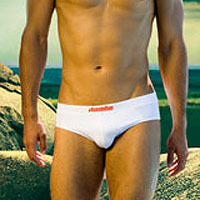
Why is this hot guy in the middle of the HTSA blog? Wouldn't you like to know...

Manchester: we were in Manchester in June. It was an OK place…nothing special, but not as horrible as, say, Aberdeen. It’s big claims to fame are the textile industry and some amazing music (Joy Division, The Smiths, Buzzcocks, Stone Roses…can any city claim a better legacy!). It got vandalized horribly during the riots this past summer/winter. Here, the textile part seems to be more important because Aussies use the word Manchester to refer to towels, linens, etc. It is a department in the local Myer store, for example (ads will say “Homewares, Kitchenware, Manchester & Fabrics”). Something similar to the US concept of ‘white goods’ even though they aren’t just white…  Doesn’t make a lot of sense ti us; the automotive industry’s hub is in Michigan, but people here don’t call cars Detroits, so why call textiles Manchester?

We’re getting used to some Australianisms: we can reply to “How you going” without thought, we occasionally say “I reckon…”. But there is still so much to learn. Like budgie smuggler…that’s one for the next HTSA. Maybe.

Posted in cultural differences, language | 2 Comments

it’s the little things…

It’s been more than 3 months that we’ve been living in Australia, and we feel that we are pretty much settled and understand “the Australian way” – at least enough to not seem like idiots (or Americans). It isn’t a really big shift from Canada – we have the same British heritage, so the basic culture is the same, and we share the same language…sort of…that’s been discussed in the HTSA posts.  But there are things about living here that are just a bit different than in Canada; they are trivial, but we still struggle with these once in a while.

This little red dot is all that stands between us and dinner some nights.

Power switches. This isn’t just an Aussie thing. Most European countries might do this…at last a few of the hotels/bed and breakfasts that we’ve stayed at in Britain have been like this. But it is still something that we have to get used to. All the outlets have a switch. In Canada, you plug something in, you have power. Simple. Here, you plug it in, turn on the outlet (or power point — not to be confused with PowerPoint — or some term like that) and you have power. Not often an issue, but there are times when it is noticeable, such as when we plug in our iPhones at night  (we use them as alarm clocks) and forget to turn on the outlet. They last through the night, but are too run down to make it though the next day. Or even odder: the range (cooktop, stove, oven, hob, whatever) has to be turned on before it can be turned on. So, we’re (read: Dan is) making dinner and we (he) turn(s) on the oven or a burner and then realize later that nothing is happening because we (he) forgot to turn on the main power. Strange. And silly… But this means that we’re saving a few pennies in ambient power use, too. It also means that Lisa doesn’t have to worry, as much, about her OCD tendency to check and recheck that the kettle is turned off… just in case the cats decide to make a cup of Earl Grey while we’re at work.

Steering wheel is on the right-hand side of car. Which means…you get in the right-side door. Unless you forget. This isn’t maybe a ‘little thing’ but is trivial really.  Dan, well, he’s an idiot. He still will, occasionally and usually when alone, walk to the left-hand side of the car, open door…and then notice that he is in the wrong place…and do something creative like take an envelope out of the glove box, close the door, and walk away like that is exactly what he meant to do.  It’s not a problem once in the car – he doesn’t drive in the wrong lane. Just occasionally forgets where the steering wheel is. Lisa, however, is good – she hasn’t made this mistake yet, nor has she driven on the wrong side of the road.

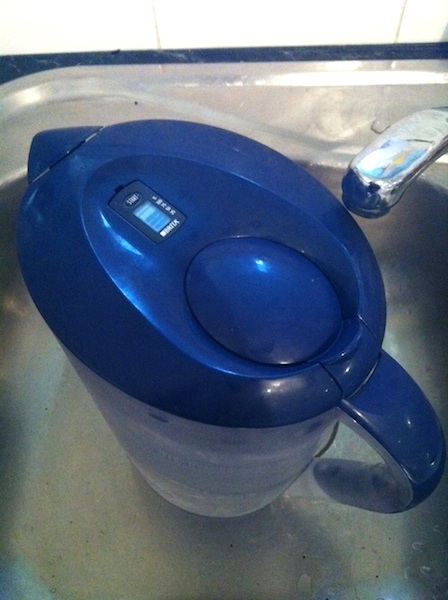
It's going to get really hot here, so we're going to be drinking a lot of water. It would be nice if we coud easily fill the Brita (the water here isn't great, needs a bit of filtering) so we can keep it in the fridge.

Kitchen sinks are extremely shallow. It seems that there is one company that makes plumbing fixtures in Australia; everywhere, we see the same shower head (and it isn’t anything special). And every 2-hole kitchen sink we have seen is the same: a large sink, a smaller sink, and a draining rack, all one piece. But the large one isn’t very big, and the smaller one is tiny. And they are barely deep enough to put our Brita water jug in to fill it under the tap. It is easier to fill it with a glass. This may seem of little significance to most readers of this blog… but these are the small details that make us wonder about this place. It’s a little thing, but something you deal with every day.

People use full names. Dan is Daniel on everything official. And being Australia, everything is official. Lisa, being Lisa (not something like Elizabeth shortened), doesn’t have this problem.  When Dan was signing up for his cooking classes they made him sign up as Daniel because that’s what the passport says.  Dan’s email at work is Daniel Given; he sends an email and signs it Dan, people respond to Daniel. People call him that…he hates it. We’re thankful that they don’t (typically) include middle names.

Lisa is being a complete rebel by not wearing her shoes, or even her moccasins, in the house. And she is risking spider bites on her toes. She may, or may not, be wearing a thong (and risking spider bites!)

Shoes in the house. Australians don’t take their shoes off in the house; some Brits do, apparently, but not the Aussies. We know that this isn’t even a custom that all Canadians adhere to, but we are used to removing our shoes when we enter a house. And we are used to having guests take off their shoes, the minute they come in the door; we didn’t ask – it was just something that people did, automatically. And we’re used to not even wearing our own shoes in our own house. But the culture here is that you wear shoes indoors and out. Probably has something to do with the relationship that Australians have with the outdoors (or the risks of spider bites!); there isn’t really that  much of a distinction between what is in and out sometimes, what with the great alfresco dining areas that most houses have (and the lack of weatherstripping, as previously mentioned). Sure, we’ve typically worn slippers in the house anyway, so it isn’t that much of a stretch to leave shoes on, but it is a slow conversion; this is particularly true in warmer weather, when we would tend to go barefoot (i.e., 2 months in Canada; 10 months in Oz). Lisa still wears her Canadian suede moccasins on cold days; Dan wears his puffy North Face slippers. But we don’t go outside in them. Or at least not past the barbecue, or the laundry line (yes, we have one! And Lisa uses it regularly!) or maybe the mailbox. This will all probably change as it gets really hot, and we switch to thongs…flip flops for those in North America, not underwear (we’ll try to restrict walking around in those thongs to indoors; sorry…. a scary mental image of Dan in that type of thong).

Posted in Australia, cooking, cultural differences, driving, shoes, spiders, weather | 5 Comments

the steep and winding road…

When we got home from the Spirit of the Land festival last weekend, Lisa saw an ad in the local paper (the Daily Advertiser) for the Batlow Apple Blossom Festival this weekend. Since we are trying to experience as much of this region as we can, and we like apples and apple blossoms, we started making plans. On Saturday morning we got up early, packed a lunch and headed off into the Snowy Mountains.

Except for the gum trees, this could be a photo of northern England. The drive into the Snowy Mountains is beautiful.

Batlow is a town of 1450 people about 100 km south east of  Wagga, getting into the mountains. The road we took to get there went through Adelong. It is, thanks to our gps, probably the shortest way and also the most scenic way. It isn’t the fastest way or the safest probably. We were on a secondary road through Tumut Shire, and even the major roads in this area aren’t big highways. This one had a lot of signs pointing out that it was steep and winding, and it was. However, in the overall scheme of things, when you compare it to what we often drove through in Jasper or what we did in the English Lake District back in June, it wasn’t that bad. It was, in fact, very similar to the Lake District; the hills and rocks and creeks were very similar, and the fields were full of sheep. What was different is that there were, thankfully, no stone walls lining the roads.

As we were driving toward Batlow, Dan was wondering what people do with all the horses we see in the paddocks. Well, we learned: at weekend, they saddle up and beat each other with rubber weapons.

When we got to Batlow, we were actually a bit disappointed with the festival. It was too kid-oriented. Most of the vendors were selling toys and lucky dips (aka kids’ grab bags), and most of the activities were geared for young people. Even the photography exhibit was filled with kids’ pictures of their cats (cute! but still… a bit boring) and trips they’d taken to the zoo (did include Koala pics – but not the same as seeking them in the wild). And the worst part of our trip was that our main reason for going there – the primo event – was also targeted at kids: the pie eating contest!  People we know here still talk about Dan’s bravery at entering the Ganmain pie eating contest, so we thought he could build on his legendary status by eating a Batlow apple pie; we would announce that he had done it by sending out an invitation to watch him in a third contest later this year at the Young National Cherry Festival. But this one was a bit of a bust. Contestants were given an individual size pie covered in whip cream (the spray can kind) and they had to eat it with hands behind their backs. So it was really just a humiliation game – there wasn’t even an official timer – and the only entrants were kids. So Dan didn’t bother. Oh well, there’s still Young coming up (and that one promises to be messy…what does one wear to a cherry pie eating contest?).

OK, so 3D chalk art is a bit cheesy, but they say that apple pie and cheese go together.

Aside from a few craft/food stalls (yes, sausages wrapped in white bread are available everywhere – ick!), the other highlights of the day were a jousting display (the festival had a strong medieval theme going, for some reason) and an urban chalk artist. Unfortunately, this guy was off in a corner of the festival grounds (just past the apple sling-shot event – again, geared at kids) so he didn’t get too many visitors. A real shame, since his chalk art was absolutely fantastic. He was just putting the finishing touches on a Sword in the Stone 3D image, so he invited us to take a photo with his masterpiece. Once Lisa climbed “up” on the rock to try to pull the sword from the stone, a small crowd gathered. Could she do it? Nope! An older gentleman then gave it a try; still no luck! It turns out that there is an annual Chalk Art Festival here, too (this year it was held in Parramatta, mid-October). We may just put that on our to-travel-to list for next year.

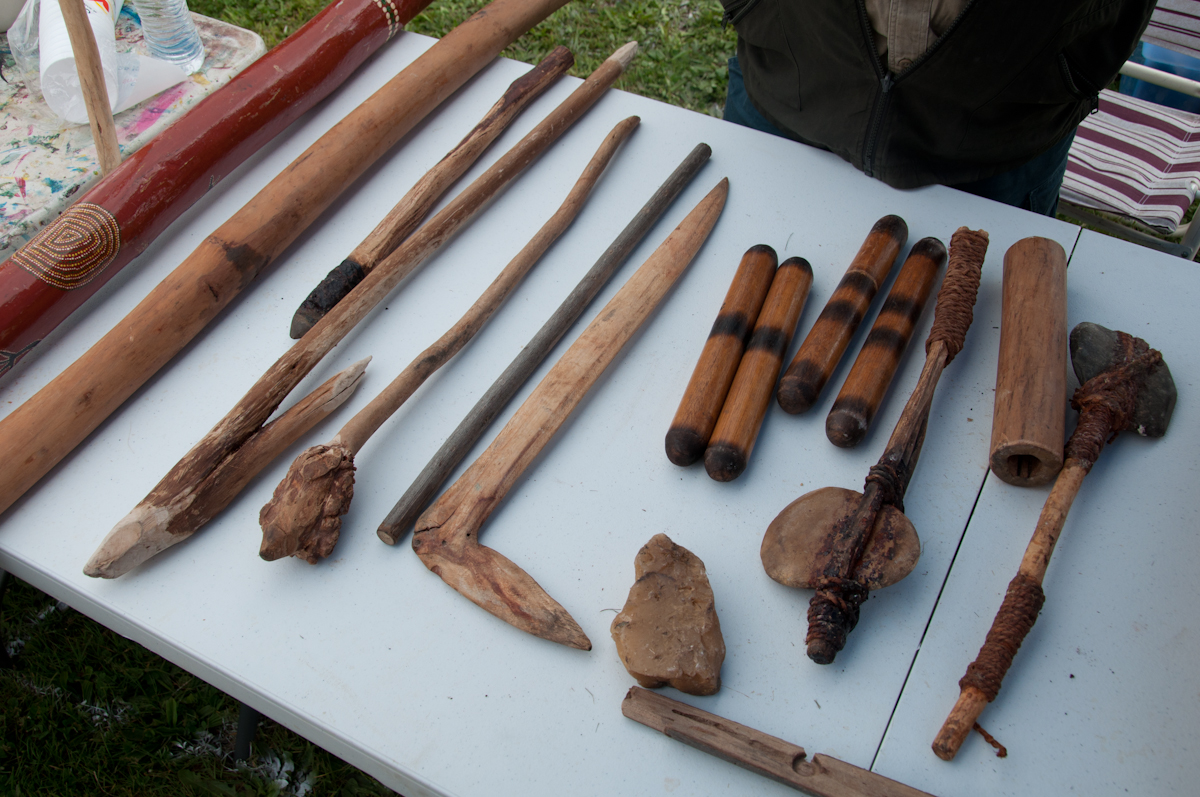
The L-shaped one in the middle is a hunting boomerang. First, they roust out the roos with the 'normal' boomerang, then throw this at its legs to trip it. Then you hit it with the bonking stick that is two tools to the left of it. Roos are pretty big...doesn't seem like that bonko would do a lot of damage.

The most entertaining thing at the festival was that we had a long chat with an indigenous woman (maybe Wiradjuri, not sure though) who works for the local parks service. She was there with a display of traditional tools that she takes around to schools to teach kids about Aboriginal culture. Given that we know absolutely nothing about it, what she told us was very informative. She told us, for example, that there are different types of boomerangs and discussed how each was used.  She had on the display table some different bowl-like vessels made of bark, and she explained how they were created. She showed us an emu call. And she had a didgeridoo, of course. That was interesting because she said that as a woman, she was allowed to handle it but not to play it. She could hand it to Dan, and even though he is white he would be allowed to play it because he is male. But she can’t play it, even though it is from her tribe.

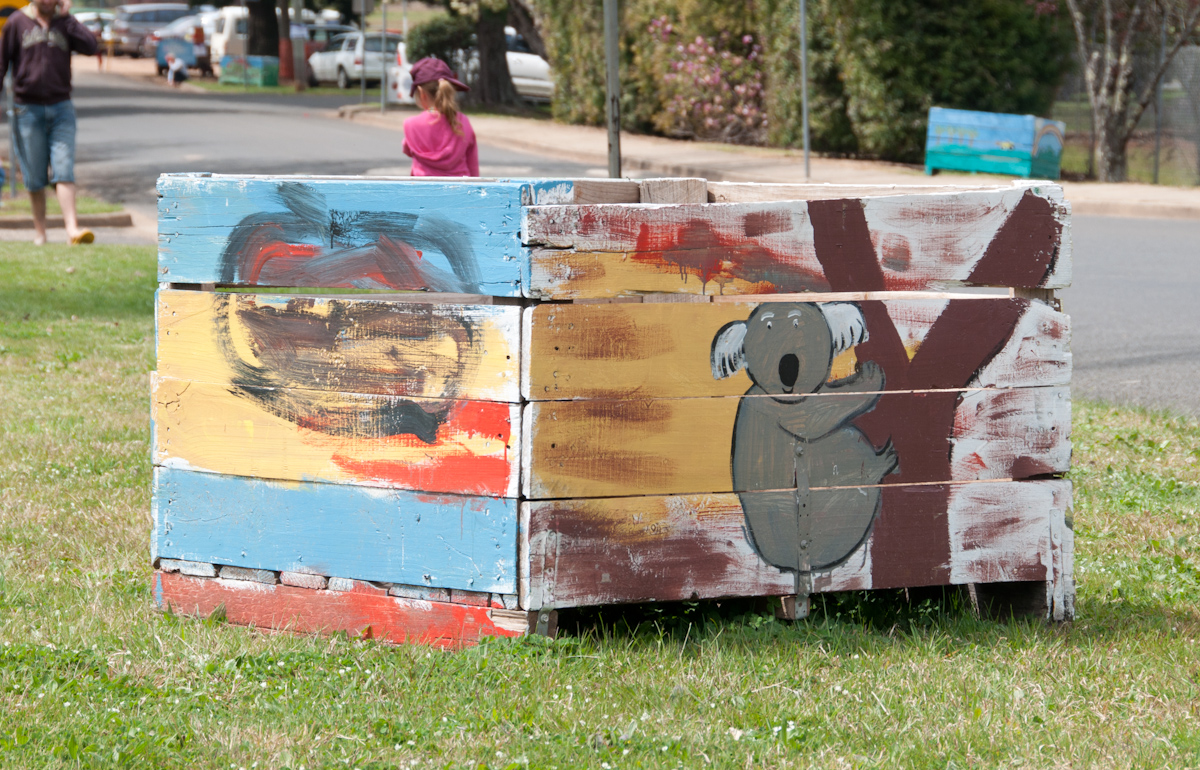
The streets of Batlow are littered with apple-picking boxes. We're not sure if they were just there for the festival, or they are there permanently for people to store their koalas in.

We did buy some apples at the festival. They grow good apples in Batlow! It gets cold enough to make them crisp, unlike the BC apples that we have been eating in Alberta for the past decade that were never really satisfying. Lisa still thinks nothing can beat a mac from Meaford… or maybe Thornbury, but considering we are in a climate more suited to citrus, the Batlow apples are more than acceptable. And we bought an apple cookbook published by Batlow apple producers that has some really interesting recipes, both sweet and savoury. It will be fun trying some of them. And, on the way out of town, we stopped at a little bakery/cafe and lucked upon the last two pies  – the same ones they were eating in the contest. So Lisa gets to try one, and Dan gets to have his without the humiliation of smearing crappy synthetic whipped cream all over his face.

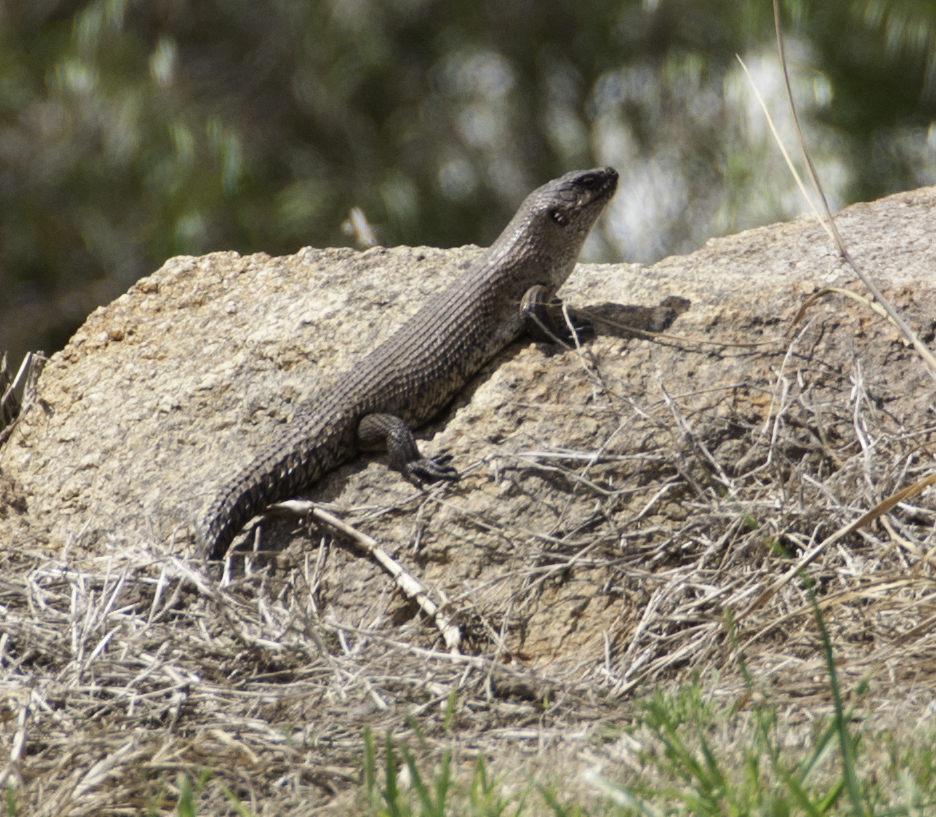
This black rock skink was sunning himself in the picnic area at Adelong mine. He's about 18 inches long, which seems pretty big from a Canadian perspective but he's only about 1/4 the size of the monitor lizard Dan saw earlier in the week. What a cool place to live!

On the way home, we stopped at a historical site on the edge of Adelong. It is the site of an old gold mine, that is in ruins now. Sadly, the site was damaged in last year’s flood and the walking paths are still closed to the public. Happily, today’s paper mentioned that they have received funding to fix them up; the trails may be open in December, and we’ll definitely be back! The other good news from this side-jaunt was that Lisa did some awesome lizard spotting… well, actually, a skink. He was sunning himself on a rock just below the ruins viewing platform. Another cool animal to add to our growing list. We’re still on the hunt for a blue-tongued lizard (so far, the closest we can get to finding one is on a beer label).

Posted in agriculture, apples, Australia, Batlow, bogans, driving, fall fairs, farmers market, festivals, food, horses, koalas, lizard, market, mountains, pie, Riverina, road signs, rural life, shows, skink, small town culture, Snowy Mountains, traffic signs, wildlife | Tagged | 2 Comments